
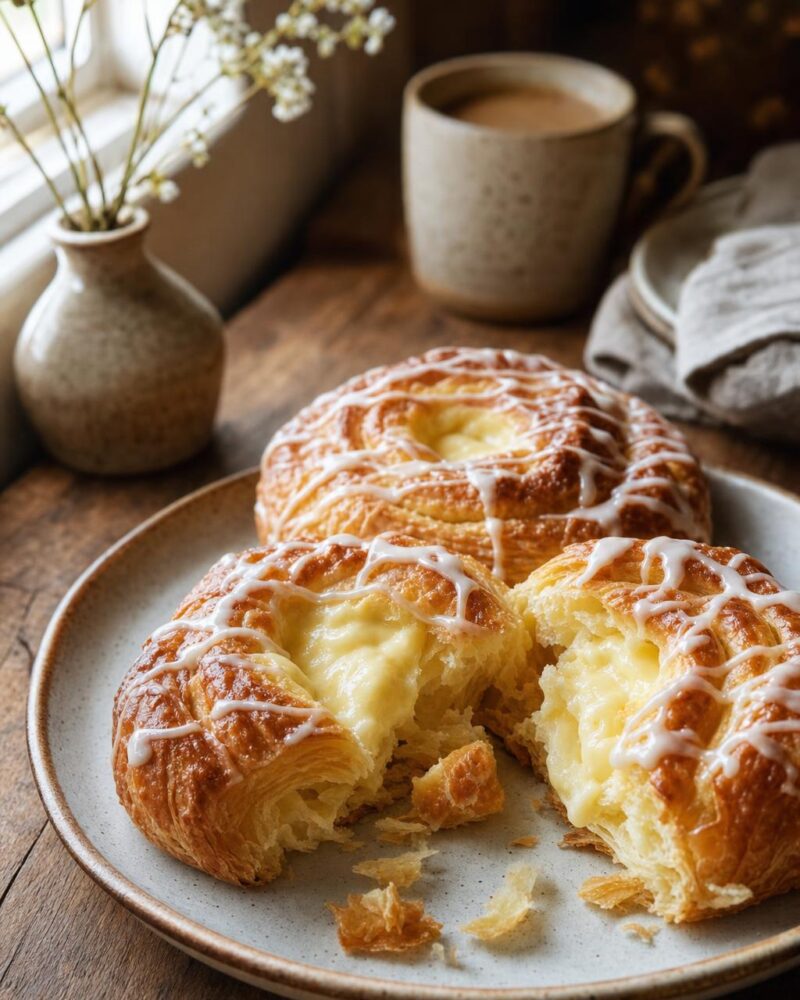
Wienerbrød — Danish pastry — is the laminated wonder that Denmark gave the world: buttery layers of yeasted dough folded around a block of butter, then shaped, proofed, and baked until shatteringly crisp outside and feathery within. The Danes perfected the technique in the 19th century, and Danish bakeries still make the best versions, filled with custard, jam, or marzipan and finished with a sweet glaze.
Why this recipe works: Danish pastry is all about lamination: a yeasted dough is wrapped around a block of cold butter and rolled and folded repeatedly, creating dozens of alternating layers of dough and butter. In the oven, the butter’s steam pushes the layers apart into the characteristic flaky, airy structure. The dough is rich with butter and sugar, and the fillings — custard, raspberry jam, marzipan — are what make it a pastry rather than bread.
Key ingredients
- Flour, milk, yeast, and sugar: the dough.
- Cold butter: the lamination block — quality matters.
- Eggs: in the dough and the glaze.
- Fillings: vanilla custard, raspberry jam, or almond paste.
- Pearl sugar or icing: the finish.
Tips for the perfect wienerbrød
Keep everything cold — the butter block and the dough — and work quickly during the folds so the butter never melts into the dough. Do at least three single folds (letter folds) with chilling between each. Roll to an even thickness and shape into spirals, braids, or pockets around the filling. Proof until puffy but not doubled, then bake at 400°F until deep golden, 15 to 20 minutes. Glaze while warm.
Variations and storage
Try the classic spandauer (custard-filled pocket) or the cinnamon snail, or fold in chocolate. Danish pastries are best the day they are baked; they keep 2 days in a sealed container and reheat well in a 350°F oven for 5 minutes. The unbaked dough freezes beautifully for 2 months.



Join the conversation
Only members can comment — it takes a few seconds to create a free account.
Log in Create an account