
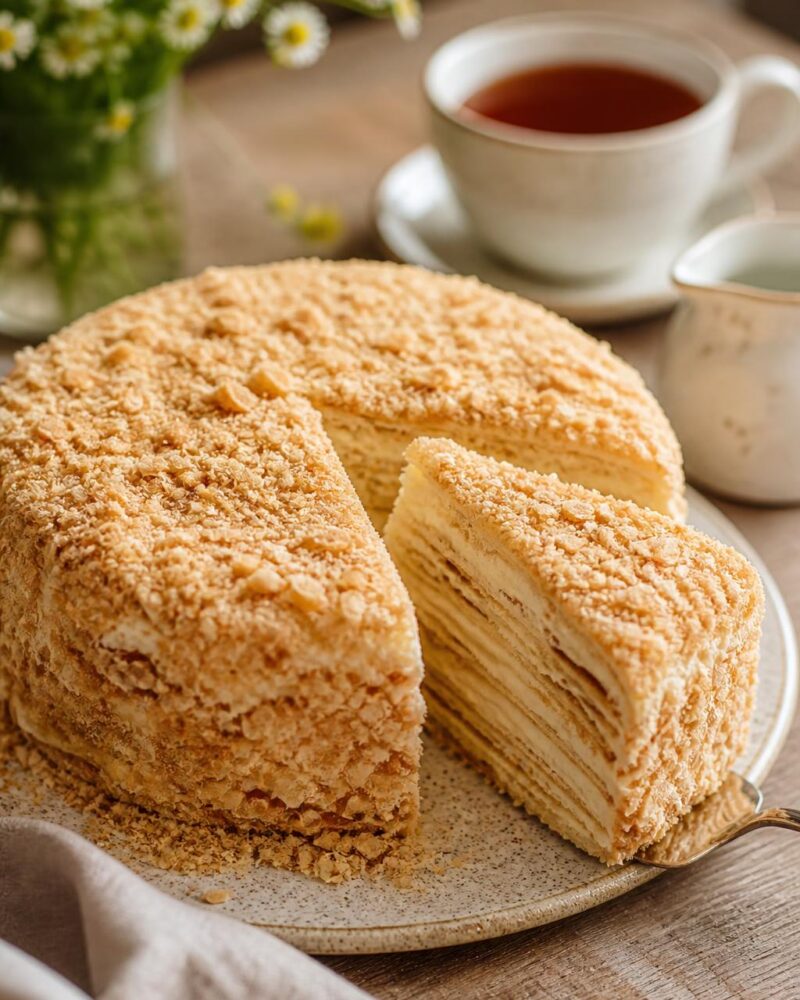
Napoleon cake is Russia’s grand layered classic — many sheets of shatteringly crisp flaky pastry stacked with a silky pastry-cream filling, pressed, chilled, and cut into neat slices. It is said to be named for the French emperor, though the Russians have made it entirely their own; every celebration table from Moscow to Vladivostok features a Napoleon, and every family argues about the perfect cream-to-pastry ratio.
Why this recipe works: The pastry layers are baked until deeply golden and crisp, like oversized puff pastry crackers, then stacked with a generous custard cream — traditionally a boiled custard of milk, eggs, sugar, and butter. The assembled cake rests under a weight for several hours, so the crisp layers and cream soften into a cake that slices cleanly, with a satisfying mix of tender cream and delicate pastry crunch.
Key ingredients
- Flaky pastry: puff pastry is the easy, excellent shortcut — or make the classic rough-puff dough.
- Milk, egg yolks, and sugar: the custard base.
- Butter: whisked into the cooled custard for richness.
- A little vanilla or lemon zest: the perfume.
- Pastry crumbs: the classic finish over the top.
Tips for the perfect Napoleon
Bake the pastry sheets until deeply golden and fully crisp — underbaked layers turn chewy instead of shattering. Make the custard until thick, then whisk in the butter off the heat and cool completely before assembling. Stack the layers with generous cream, then wrap the cake and chill under a light weight for at least 6 hours — this melds the layers. Crumble the trimmings over the top and sides. Slice with a serrated knife.
Variations and storage
Use a mascarpone or whipped-cream filling for a lighter version. Napoleon keeps 3 to 4 days in the fridge and actually improves with rest; it freezes well for 2 months, though the pastry softens on thawing.



Join the conversation
Only members can comment — it takes a few seconds to create a free account.
Log in Create an account